Arrival and secure
Aircraft parked, safety conditions confirmed and gate state understood.
A turnaround is a practical place to test shared operational intelligence: a chain of time-sensitive activities, multiple partners and clear human accountability.
Illustrative concept only. It does not propose autonomous fuel handling, pushback, security decisions or safety-critical action. Those activities remain subject to local authority, regulation and validation.
An aircraft turnaround involves a network of teams, equipment, constraints and dependencies. The goal is not to automate every step; it is to make the state, risk and next best action clear in time to help people intervene.
Aircraft parked, safety conditions confirmed and gate state understood.
Passengers and baggage leave the aircraft through coordinated activity.
Cleaning, catering, water, waste and ground power each have dependencies.
Critical work proceeds under established local operating and safety controls.
Passenger, gate, crew and baggage status need a coherent shared view.
Responsible teams complete their own checks and attestations.
Authorised personnel decide when the aircraft is ready to leave the stand.
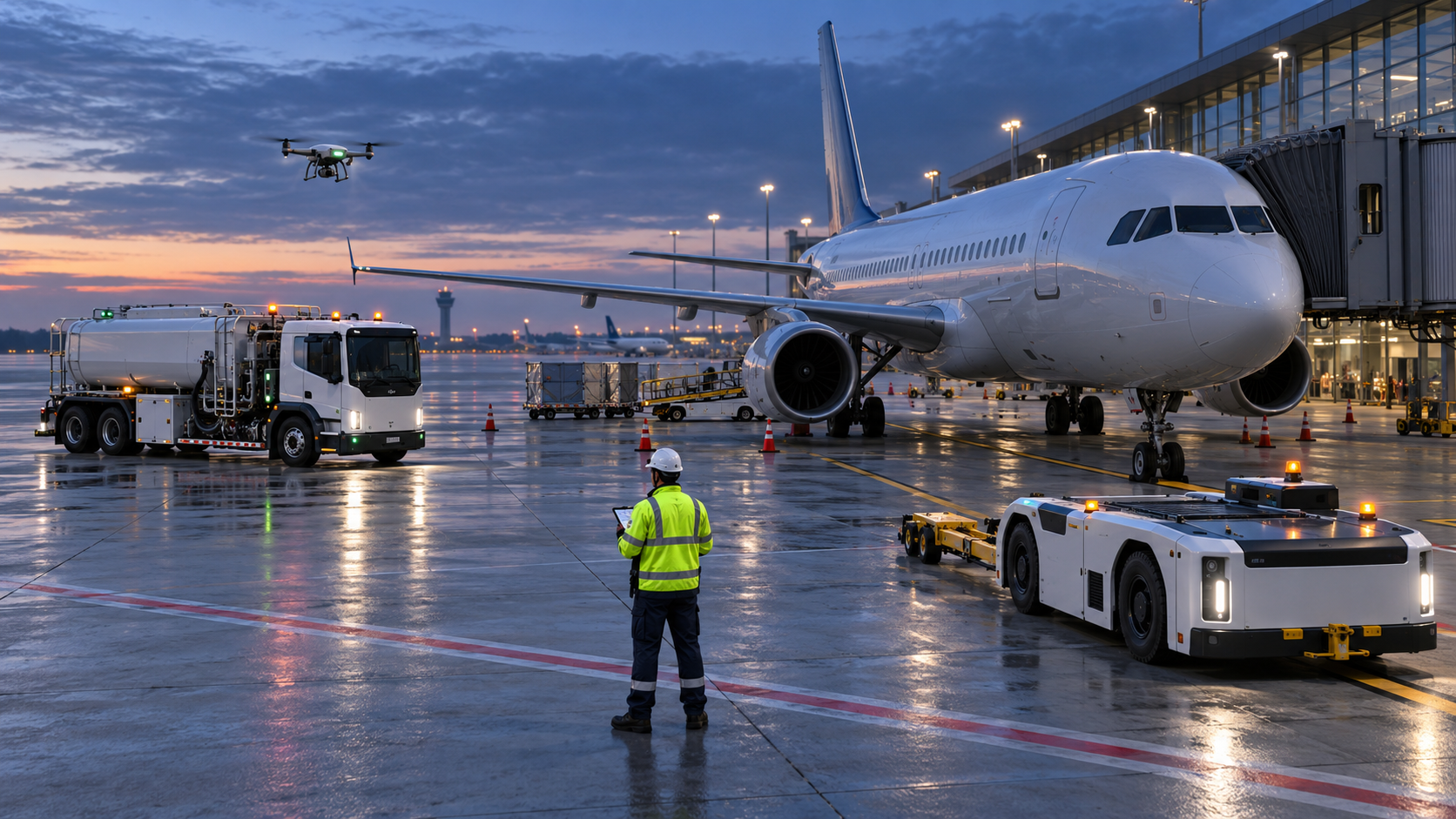
A 4D Digital Airport Twin can bring together approved operational data, sensing and partner updates. Its role is to support the people who own the work—not to erase their authority.
See whether required resources, tasks and constraints are present, current and sufficiently reliable.
Identify a likely delay or conflict, including uncertainty and the operational dependencies affected.
Offer practical, reversible options to the named operational owner, with the evidence visible.
When data is uncertain, conditions fall outside the agreed envelope or safety is involved, pause and route the decision to a person.
A useful pilot is explicit about what the system may observe, recommend or support—and what must remain with authorised people and established operational procedures.
Track the status and confidence of available data; surface missing resources, incomplete handoffs and emerging dependencies.
Compare recovery options and make consequences clear, while allowing a human owner to accept, adapt or decline them.
Fuel handling, pushback, security, aircraft-release and other safety-critical actions remain under approved local procedures and accountable authority.
The first pilot should validate its operating value and safety assumptions before seeking any increase in automation.
Name the workflow owner, partners, authority limits, stop conditions and escalation route.
Measure turnaround readiness, delay causes, handoffs, data quality and operator effort.
Test visibility and recommendations alongside existing procedures without operational control.
Decide whether to stop, redesign, retain decision support or progress cautiously.